Oct 24, 2026Buying Guides
Phone Chains, Straps and Charms: Materials, Hardware and Packing
Wrist strap, crossbody chain, keychain charm — three products sold as one range, and the material and hardware choices that separate them.
A phone chain range is usually bought as a single line and sold as three different things: a wrist strap, a crossbody chain, and a charm that hangs from a bag or a keyring. They share a colour story and almost nothing else. The material sets the retail tier, the hardware sets the returns conversation, and the packing sets the shelf.
Three Formats in One Range
Wrist strap
A short loop that goes around the wrist. In this range that means a braided nylon cord, folded into a loop and bound at the middle with the same cord, ending in a metal spring clip. It is the simplest construction in the range and the one with the fewest parts to go wrong.
Crossbody chain
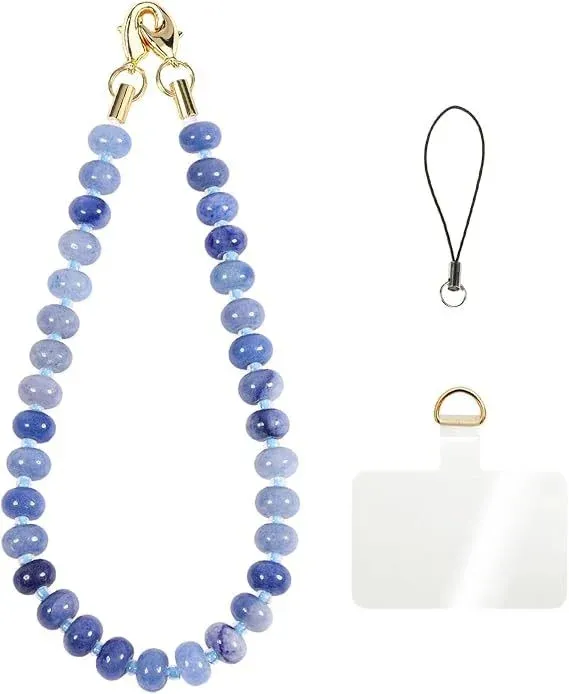
A long chain worn across the body. Construction varies more than buyers expect. Glass or crystal beads strung on a cord with a lobster clasp and a connector ring. A single strand of crushed-stone beads with gold-tone spacers. A wide woven polyester band spliced from two colours, with a metal clasp at one end and a woven pull loop at the other.
Keychain charm
A decorative piece on a keyring or a carabiner-style ring. Water-crystal angel figures on a rhinestone strap, plush birds, enamel flowers on zinc alloy, acrylic letter groups with pom-poms, PU leather shapes on a leather wrist loop. This is the format where the design carries the value and the hardware has to match it.
Material Sets the Tier Before Anything Else
Glass and crystal beads. The heaviest and most retail-facing of the bead options. A gradient bead chain reads as a designed object, and the colour direction is the whole product, so the colour reference has to be approved on the actual bead, not on a digital swatch.
Acrylic. Lighter, and it takes colour and shape more freely: round beads with a tuft inside, heart shapes, letter groups. Acrylic is where a range can carry a wide palette at a lower material cost.
Enamel on zinc alloy. A metal body with a poured enamel face. The enamel colour is set per zone, so a multi-colour charm needs its zones confirmed on the sample rather than on the artwork.
Plush. A sewn body with a metal ring and a strap at the top. Soft-goods construction means the specification is about stitching, fill and trim, which is a different supplier conversation from beads and hardware.
PU leather. Cut and stitched shapes on a leather wrist loop. Edge finishing and stitching are the visible quality signals, so both belong on the sample checklist.
Woven nylon and polyester. Cord and webbing. The nylon wrist strap is hand-braided and bound; the polyester crossbody band is woven and spliced. Weave density and splice quality are the two things to compare between suppliers.
Hardware Is Where Returns Start
Lobster clasps. The standard connector on bead chains and woven bands. Gold-tone on the glass and crystal styles. The clasp is the part that gets opened and closed most, so its spring feel belongs in the sample check.
Spring clips. Used on the short wrist strap. A metal clip on a braided cord, small enough that the cord attachment is the critical point rather than the clip itself.
Plastic clasps. Used on the lower-cost bead chains. Lighter and cheaper, and appropriate where the bead strand is the value and the clasp is not.
Rings, patches and connectors. A connector ring between the clasp and the phone, and on some styles a transparent patch that sits between the phone and the case. The patch is a separate part in the bill of materials and is often forgotten when a buyer counts components.
One detail worth stating plainly: not every style in a chain range supports logo printing. In this range one woven band does and several bead and strap styles do not. A buyer who assumes a logo can be added across the line will find out at the sample stage, which is late.
Length Is a Specification
For a chain, length is not a size attribute — it decides how the product is worn and therefore which customer it sells to.
A 13 cm beaded charm sits at the wrist or hangs short from a bag. A 15 cm wrist strap is a wrist loop. A 120 cm and a 150 cm chain are crossbody lengths, worn on the shoulder or across the body, and the two lengths suit different body heights and different garment weights.
Confirm the length per SKU, in centimetres, on the specification sheet. Where the supplier sheet does not state a length, do not infer one from a photo — the same product photographed on a model can read as a completely different length.
Packing: Bulk, Independent, or Retail
The range mixes formats. Braided wrist straps are commonly supplied bulk. Bead chains, woven bands and most charms are packed independently, which is what a retail or e-commerce seller needs but what changes the carton count and the packing labour.
For a private-label programme, the packing decision should be made with the length and colour decision, not after it. A chain that ships bulk in one colour and independently in another creates two packing processes for one SKU family.
A Short Spec Sheet for a Chain Programme
Format: wrist strap, crossbody chain, or charm. Material, and for assemblies, the material of each component. Hardware: clasp type, ring, patch. Length in centimetres where the supplier states it. Colour reference, approved on the actual material. Packing format. And whether logo or colour customisation is available on that specific style.
The last line is the one buyers skip, and it is the one that decides whether the range can be branded at all.
Questions Buyers Ask
Should a chain range be one material or several?
Several, in most cases. A single-material range limits the price ladder. A mix of acrylic, glass, plush and metal lets one colour story run from an entry price to a gift price, with the hardware and packing carrying the difference.
What should be checked first on a bead chain?
The clasp and the connector. Beads are visible in a photo and easy to compare; the hardware is not, and it is what the customer touches every time they put the phone down.
Can we add a logo to every style?
No. Customisation is style-specific in this category. Ask per SKU, in writing, before you build the range around a branded position.
Material decides the price. Hardware decides the returns. Packing decides the shelf.
Max Tech supplies phone chains, straps and charms alongside its phone case, AirPods case and phone stand ranges, with OEM and ODM work across material, colour and packaging. Send your target formats and market to start a quote.