Oct 24, 2026Buying Guides
Phone Grips, Stands and Car Mounts: Fix the Mounting Type First
Suction grips, ring holders, desk stands and car mounts are bought as one category and specified as four. Here is what changes in the spec.
Buyers tend to file grips, stands and car mounts under one heading, then discover at sampling that they are four different products with four different specifications. The mounting method decides the structure, the structure decides the material and process, and the material decides what you can put in the colour range and the retail pack.
Four Product Types Behind One Category
Grip pads and suction pads
A flat silicone pad that sits on the back of a phone. In this range the pad is heat-press moulded silicone, and the shape carries most of the design work: round, square, apple-shaped, bow-shaped. The face is usually a bubble texture, which gives the pad a grip surface without a separate part.
The specification is short: pad size, thickness, colour, and the packing format. Some styles add a moulded strap that runs from the edge of the pad, which changes the tool but not the material.
Ring holders
A ring on a base, usually with a magnetic ring on the back. The base can be silicone on its own, or a zinc alloy ring assembled onto a silicone element with an N52 magnet. The ring rotates through 360 degrees, and that rotation is the adjustment buyers test in the hand.
Because the ring is a metal part, the finish becomes a specification: CNC machined and electroplated, with the plating colour matched to the silicone element. That is a different quality conversation from a moulded pad, and it belongs in the sample brief.
Desk stands
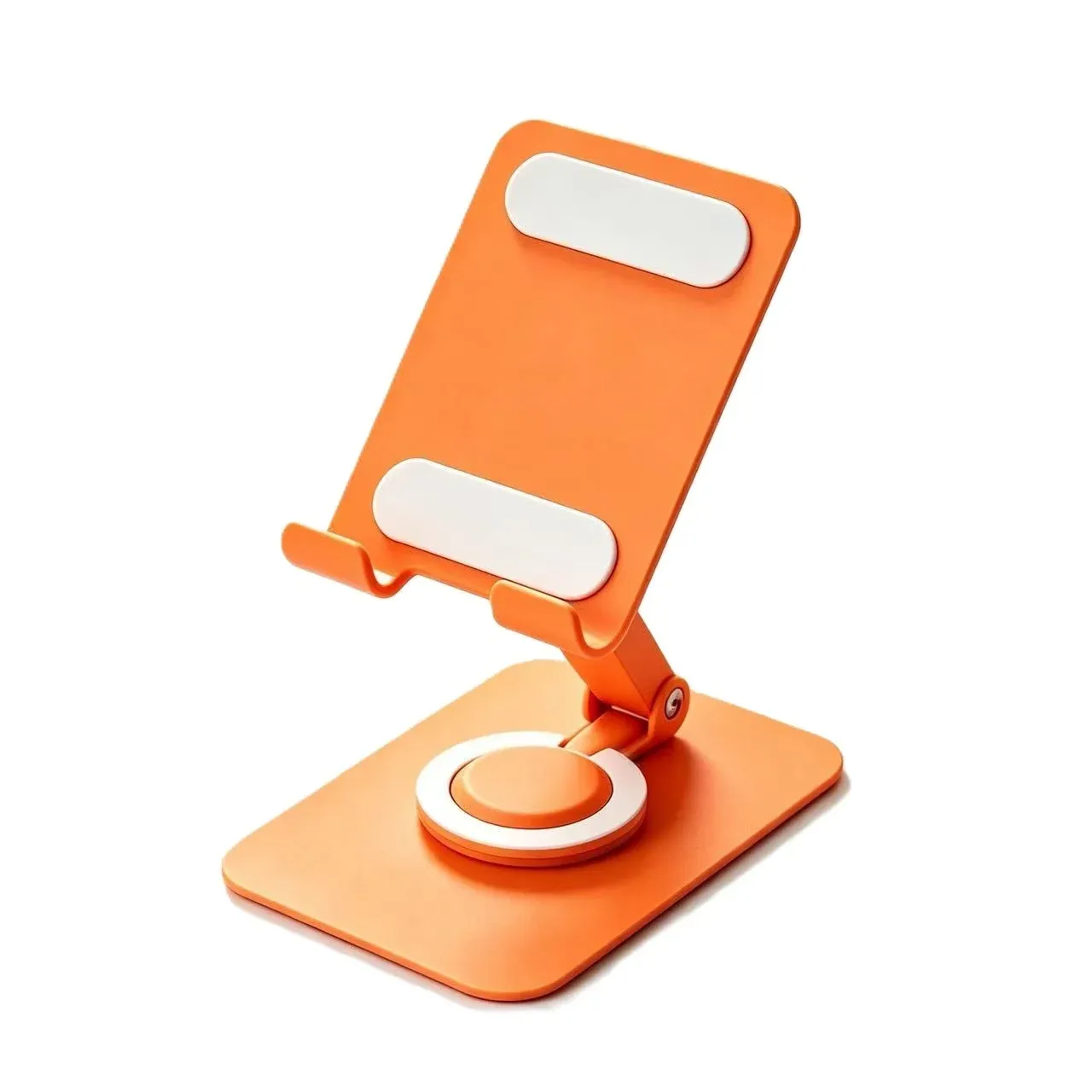
A folding arm on a rotating base, made in metal. The arm angle and the base rotation are the two adjustments buyers actually test, and both are structural rather than decorative. This is the type where the colour programme is usually a small set of metal finishes rather than a broad palette, because the part is anodised or coated rather than moulded.
Car mounts
Two mechanisms dominate. One is a foldable arm with a rotating head, mounted on a soft rubber and aviation aluminium body with dual-sided suction and vacuum magnetic mounting. The other is a compact magnetic head on an ABS body, positioned near the air vent.
Car mounts are the type most often specified by the shape of the interior rather than by the shape of the phone, and that is worth deciding before the sample, not after.
The Mounting Method Is the First Spec
Suction
The pad or base meets a flat surface. What the buyer specifies is the surface it is intended for and the size of the contact area. Two pads with the same diameter but different thickness behave differently on a textured or curved surface, which is why the thickness belongs on the sheet next to the diameter.
Magnetic
The product meets a magnet rather than a surface. That shifts the specification to the magnet grade, the ring diameter and the position of the ring relative to the camera cut-out. In this range the magnet is stated as N52 where the sheet records it, and the metal parts are specified by alloy and plating.
A magnetic mount also raises a compatibility question the buyer has to answer for their own market: whether the phone or the case in use carries a magnetic ring. That is a decision about the range, not a claim about the product.
Material and Process Follow the Structure
Silicone, heat-press moulded. The base material for grip pads, and the outer element on ring holders. It carries colour well and takes a moulded texture, which is why the bubble face is common. The sheet records the pads as wear-resistant and reusable, and that is the wording to keep.
Zinc alloy, CNC and electroplated. Used for the ring and the metal body on ring holders. Plating is the finish, so colour approval has to happen on the plated part rather than on a colour chip.
Soft rubber with aviation aluminium. The car mount body. The rubber carries the suction side, the aluminium carries the arm and the head. Two materials in one part means two inspection points.
ABS. The compact vent mount body. Moulded, light, and finished in solid colours. It is the simplest part in the range to tool, and the specification is correspondingly short.
Metal, coated. The desk stand. Anodised or coated colour, folding arm, rotating base. The colour range is usually four metal finishes rather than a broad palette, because the finish is the product.
What Actually Changes Between a Grip and a Mount
A grip is a single part with a colour. A mount is an assembly with a mechanism, and the mechanism is what the buyer tests.
For a grip, the sample check is the face texture, the edge, the colour and the pad thickness. For a ring holder, add the ring rotation and the plating colour match. For a desk stand, add the arm fold and the base rotation. For a car mount, add the mounting side and the position of the head.
That difference is why a supplier who moulds pads well is not automatically the right source for a car mount: the second product is an assembly, and assembly quality is a separate capability.
Colour, Packing and the Retail Format
Colour ranges differ by type. The silicone pads run broad palettes across twelve and ten colours. The ring holder and the car mount run four to five. The desk stand runs four metal finishes.
Packing differs too, and it is usually decided late and then causes the delay: moulded pads are commonly supplied bulk or in a single poly bag, with pearl bags and clear double-sided euro-hole bags as retail options. The car mount is boxed. The difference matters because a boxed product needs artwork, and artwork needs its own approval round.
A Specification Sheet for a Stand Programme
Material and, where the part is an assembly, the material of each element. Process: heat-press moulding, CNC plus plating, or moulding. Mounting method. The dimensions that matter for that type: pad diameter and thickness, ring diameter, arm length, contact area. Colour, approved on the actual finish. Packing format. And for magnetic parts, the magnet grade.
Get those lines agreed before a sample is cut. Every one of them is cheaper to change on paper than in a tool.
Questions Buyers Ask
Can one grip serve both a car and a desk?
Only if the product is designed as a mount rather than as a pad. A pad with a moulded strap is a hand grip. A foldable arm with a rotating head is a mount. The two are not interchangeable at the specification level, even when they look similar in a photo.
Does a magnetic mount need a magnetic case?
That depends on the phone and the case in use, and it is a question about the range you are building rather than about the mount alone. Decide it before you commit to a magnetic-only line, because it determines whether you also need to carry magnetic rings or patches.
What should be checked on a plated ring before approval?
The plating colour against the approved finish, the edge where the ring was cut, and how the ring sits on the silicone element. On an assembly, the joint between the two materials is where a sample usually fails first.
The mounting method is the specification. Everything else — shape, colour, packing — is decided after it.
Max Tech supplies silicone grips, ring holders, desk stands and car mounts alongside its phone case and phone chain ranges, with OEM and ODM work across material, colour and packaging. Send your target types and market to start a quote.